Question:
2 L of a gas at 1 atm pressure is reversibly heated to reach a final volume of 3.5 L. The absolute value of the work done on the gas (rounded off to the nearest integer) is \(\underline{\hspace{2cm}}\) Joules.
2 L of a gas at 1 atm pressure is reversibly heated to reach a final volume of 3.5 L. The absolute value of the work done on the gas (rounded off to the nearest integer) is \(\underline{\hspace{2cm}}\) Joules.
Show Hint
The work done on a gas during an isothermal process can be calculated using the formula \( W = -nRT \ln \left( \frac{V_f}{V_i} \right) \).
Updated On: Jan 7, 2026
Show Solution

Verified By Collegedunia
Correct Answer: 151
Solution and Explanation
The work done on the gas during an isothermal expansion is given by:
\[ W = -nRT \ln \left( \frac{V_f}{V_i} \right) \] where \( n \) is the number of moles, \( R \) is the gas constant, \( T \) is the temperature (constant), \( V_f \) is the final volume, and \( V_i \) is the initial volume. Assuming the temperature remains constant, we calculate:
\[ W = -1 \times 8.314 \times 298 \times \ln \left( \frac{3.5}{2} \right). \] Solving for \( W \), we get:
\[ W \approx -151 \, \text{J}. \] Thus, the work done on the gas is \( 151 \, \text{J} \).
\[ W = -nRT \ln \left( \frac{V_f}{V_i} \right) \] where \( n \) is the number of moles, \( R \) is the gas constant, \( T \) is the temperature (constant), \( V_f \) is the final volume, and \( V_i \) is the initial volume. Assuming the temperature remains constant, we calculate:
\[ W = -1 \times 8.314 \times 298 \times \ln \left( \frac{3.5}{2} \right). \] Solving for \( W \), we get:
\[ W \approx -151 \, \text{J}. \] Thus, the work done on the gas is \( 151 \, \text{J} \).
Was this answer helpful?
0
0
Top GATE CY Inorganic Chemistry Questions
- Which are optically active?
- Among the following, the compound with the lowest CO stretching frequency is
- The ground state of [Cr(H2O)6]2+ is
- The reaction of XeF2 with HN(SO2F)2 at 273 K in CF2Cl2 solvent yields
- The major product in the given reaction sequence is Q. The mass spectrum of Q shows
([M] = molecular ion peak)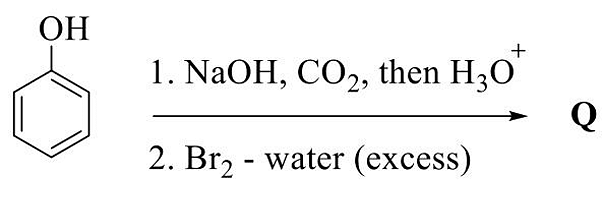
View More Questions
Top GATE CY Questions
- Ψ(x) = \(\sqrt{\frac{32}{L^3}}\)[sin(\(\frac{\pi x}{L}\)).cos(\(\frac{\pi x}{L}\)).sin(\(\frac{2\pi y}{L}\)).sin(\(\frac{\pi z}{L}\))]Find the value of E221: E111.
 what is the final product
- Which are optically active?
 intensity ratio of final product
- Which among the following is true?
View More Questions